18 August 2013

Molotov Brass (Switzerland)

The story of Molotow Brass Orkestar starts somewhere in foggy November 2007 at the Bern University of the Arts (HKB). A handful of classical of students studying classical music looking for a break of the classical concert schedules assembled and started to play Balkan folk music. After a short time today‘s six-piece band Molotow Brass Orkestar was born.

The band developped quite fast. Backed by their powerful lady on Drums, Marianne Graber, the five horn blowers started to mix whatever style of music they liked. Thus Molotow’s unique mix of Balkan and Swiss Folk music showing influences of klezmer, ska or even electronic beats started to emerge. Combined with their catching vitality they soon persuaded every kind of audience to cheer for them. Invitations to renowned festivals where coming in soon.

In the last couple of years, Molotow Brass Orkestar played at Brass: Durham International Festival in England, Lucerne Festival, European Brass Band Championships, or at the Fêtes de Genève. Other whereabouts are Bierhübeli Bern, Abart Club Zürich, Buskers Lugano, Buskers Neuchâtel, Stadtspektakel Landshut to name only a few. The band can be found on the soundtracks of three movies and has been featured on radio on at least three continents.
More HERE

14 August 2013

It Takes Brass to Play the Wagner Tuba

    By
  • BARBARA JEPSON


When Richard Wagner began composing "The Ring of the Nibelung," his visionary opera cycle, he became dissatisfied with a particular musical theme. The solution, he decided, was not to rewrite the passage but to foster the creation of a new instrument to perform it—the Wagner tuba.

Because of its range and mouthpiece, this tuba-shaped hybrid is actually played by members of the French horn section, but never mind. Developed at Wagner's request at a time when the technical capabilities of modern brass instruments were being expanded, it enabled him to fill a gap in tone color between the mellow lyricism of the horns and the penetrating brilliance of the trombones. He was inspired, in part, by the gradation of sound in military bands. In the "Ring," four Wagner tubas join an enlarged brass section that includes other orchestral rarities like the bass trumpet, contrabass trombone and contrabass tuba, creating "choirs" of gleaming brass.
These instruments play an important role in the "Ring," an epic tale of greed, revenge, love and redemption that will be presented around the globe this year during the bicentenary of Wagner's birth. In the U.S., the first complete, four-opera cycle will begin on April 6 at the Metropolitan Opera with a reprise of the Robert Lepage production. Throughout the "Ring," the brass are associated with some of the major recurring musical themes, called "leitmotifs"—leading motives linked to particular characters, concepts, props and more.

Read the full article: Wall Street Journal

13 August 2013

Royal Danish Brass (Denmark)


The Royal Danish Orchestra is considered the oldest orchestra of it's kind, tracing its origins back to 1448 and the Trumpet Corps at the royal court of King Christian I, who was crowned to an accompaniment of brass and percussion instruments. The Danish name for the orchestra - Det Kongelige Kapel - reveals that it was, in origin, an ensemble geared to supplying the music for court events, such as providing musical assistance to a visiting Italian opera company.

It was in this context that the renowned musician Christoph Willibald Gluck not only led the Royal Danish Orchestra, but also composed the music for special occasions – a notable example being the celebration of the birth, in 1749, of the later King Christian VII.

Over the years, the orchestra moved out of the court and settled down in the pit at the Royal Danish Theatre. A growing number of engagements saw an increase in the size of the orchestra, and when Johan Gottlieb Naumann carried out his reforms in the 1780’s, the ensemble numbered 46 members. It is relevant to mention here that it was at precisely this time that the Chorus of the Royal Danish Opera became permanently assigned to the Royal Danish Theatre.

Royal Danish Brass was founded in 1977 under the name The Royal Orchestra Brass Quintet. Five young brass players from The Royal Danish Orchestra, trumpeters Ketil Christensen and Søren Emtoft, hornist Poul-Erik Vilsbæk and trombonists Keld Jørgensen and Mogens Andresen, stated as an objective of the ensemble: the ancient traditions of open-minded and contemporary orchestrations, interpretations and versions retaining old music and in close collaboration with composers and colleagues, exploring new avenues in music under strict conditions of quality in every way.
Royal Danish Brass is THE Danish brass ensemble par excellence, with a high degree of musicality. There are concerts, church concerts, school concerts and 'clinics' and 'master classes' regularly.
More info HERE

11 August 2013

da Blechhauf'n (Austria)

da Blechhauf'n

is a group of seven guys, who got together to predominantly play traditional Austrian but also progressive music to entertain their listeners.
Generally, it's all about brass, however trying out numerous other genres manifests itself as a new musical tradition in brass performance, making the unforeseeable foreseeable.
When listening to them, they encourage you to allow yourself to enter into the variety and diversity of sound, word, dance and comedy, and to experience
the charm of modern tradition!

For the tuba player


09 August 2013

BonaNZa (New Zealand)

BonaNZa is made up of five professional trombone players from throughout NZ, representing the Auckland Philharmonia, the New Zealand Symphony Orchestra, and the Vector Wellington Orchestra. The members enjoy playing varying styles of music and performing in diverse places, from inside trains, busking in the coromandel or the top of the Sky Tower, to a band rotunda tour of the South Island. Bonanza played to 150,000 people at the 2009 Startlight Symphony as soloists with the Auckland Philharmonia, a world record for a trombone ensemble (unofficial but probable…)
More HERE

05 August 2013

Vienna Horns


"Director's Cut" is the title of the CD featuring the twelve horn players that caused worldwide bafflement and amazement with their Vienna horns. This time they have not produced Viennese sounds, but well-known and legendary themes from soundtracks such as Bernhard Hermann's music for Alfred Hitchcock's "Torn Curtain" as well as scores from contemporary films such as Patrick Doyle's "Harry Potter".

The ingenious arrangements for the Vienna horns are made by Alexander Wagendristel. The conductor of the recordings is Alois Glaßner. 
More info HERE

03 August 2013

Triton Brass Quintet (USA)

Triton Brass is an exciting musical collaborative comprising five of the region's most promising young talents. Prize winners at the 2005 Lyon International Chamber Music Competition and 2003 Fischoff International Chamber Music Competition, Triton is in its fourth year as artists-in-residence at The Boston Conservatory, where the group serves as both performers and instructors, and are proud to be faculty and co-hosts for the Atlantic Brass Quintet International Seminar. Triton Brass also served as chamber music faculty at the Boston University Tanglewood Institute from 2005-2010.
Among its recent performances, Triton has performed as soloists with the Boston Conservatory Wind Ensemble, the new music ensemble Alea III, and the Concord Band, and as a headline performer for an WGBH outdoor concert in front of more that 30,000 audience members. Fervent supporters of new music, the quintet has performed multiple world premieres in recitals throughout the U.S. and maintains an ongoing "call-for-scores" open to all composers and collaborators.
The Quintet performs extensively in numerous capacities, including recitals, educational concerts and residencies, formal affairs, and collaborative endeavors.
Listen HERE and HERE 

30 July 2013

Sonus Brass (Austria)

Many enthusiastic reviews in music magazine prove that Sonus Brass Ensemble, founded in 1994, has become one of the most active, intriguing, and innovative brass ensembles in Austria. In classical brass instrumentation consisting of 2 trumpets, bugle, trombone, and tuba the five musicians demonstrate a tremendous musical scope ranging from early to contemporary music and comprising original as well as cover versions. They have received international recognition for their numerous music appreciation projects:
 “Rocky Roccoco”
 "The Brass Workers"
 "The Emperors new Cloths"
"Don Quichotte and friends":
The second part of the concert consists of the play “Don Quichotte, clownish comedy”.
Plot:
The play starts with Sancho Panza’s initial complaint, “I’ve been serving my master Don Quichotte for 17 years now! Pha! But what does he amount to without me his loyal squire?! Of course, in our play, Sancho Pansa will kill the dragon for his master. And Don Quichotte will be refused by Dulcinea, and there will be fierce battles between Don Quichotte and the windmills of La Mancha. In our version of this classic there will even be casualties, but in the end director Markus Kupferblum brings all the dead characters back to life, Don Quichotte will certainly have a happy end with his beloved Dulcinea, and Rosinante gets…. let’s not divulge all the surprises!

29 July 2013

Phil's Old and Odd Brass Collection (USA)


 "Tornister"  Tenor Tuba by Cervany c.1900
This is a beautiful small Tenor Tuba or Baritone  in Bb made by Cervany primarily for the military. It is called a "Tornister" or "Rucksack" baritone. The advantage of such a small horn is obvious- it can be easily carried on a long march in a soldier-musician's backback. It is 16 1/2" lng (42cm) and has a bell 6 7/8" (17.5cm) in diameter. Note the unique design feature which has the leadpipe coming from the side opposite the bell. It is a nearly identical companion to my tiny Tornister Tuba which is only slightly larger.  The label  is written: CERVANY & SOHNNE - ZUKUNIGGRATZ IN BOHMEN.   This baritone and my Tornister Tuba were both lovingly restored by Dick Hansen in Massachusetts. They both play amazingly well for such small horns.
More old instruments HERE

28 July 2013

Brass Ambassadors (USA)

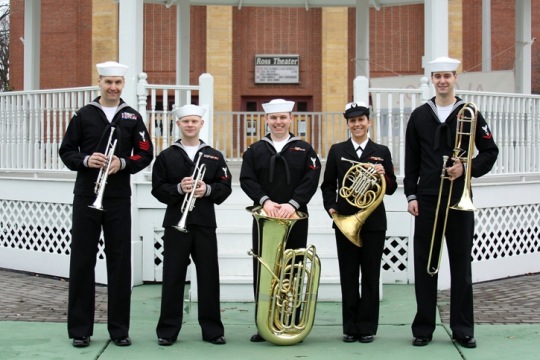
Established in 1982 and comprised of five brass instrumentalists, the Brass Ambassadors have performed throughout the Midwestern United States for military functions, public concerts, recitals, and school clinics. Led by Musician Second Class David Paff, this ensemble performs musical styles such as classical compositions, Dixieland and march arrangements.

Navy Band Great Lakes' Mission

"Pride in Service" has been the theme for Navy Band Great Lakes for more than a century. From 1911, when the band first formed, to 1917, when Lieutenant Commander John Philip Sousa served as Bandmaster, to today's Director, Lieutenant Patrick K. Sweeten, our music represents the pride and professionalism that is synonymous with the United States Navy.
Click HERE

21 July 2013

The Bay Brass (USA)

Formed in 1995, The Bay Brass, is comprised of a cooperative of players from the San Francisco Bay Area's leading performing organizations including the San Francisco Symphony, the San Francisco Ballet Orchestra, the San Francisco Opera Orchestra, and Symphony Silicon Valley. The aim of the group is to present both large-scale symphonic brass ensemble works and compositions for smaller combinations of players in acoustics which complement the wonderful sound of brass. In addition, The Bay Brass programs concerts of remarkable diversity, combining the traditional brass repertory with jazz and other contemporary styles, including the works of some of today's most influential composers.
More info HERE